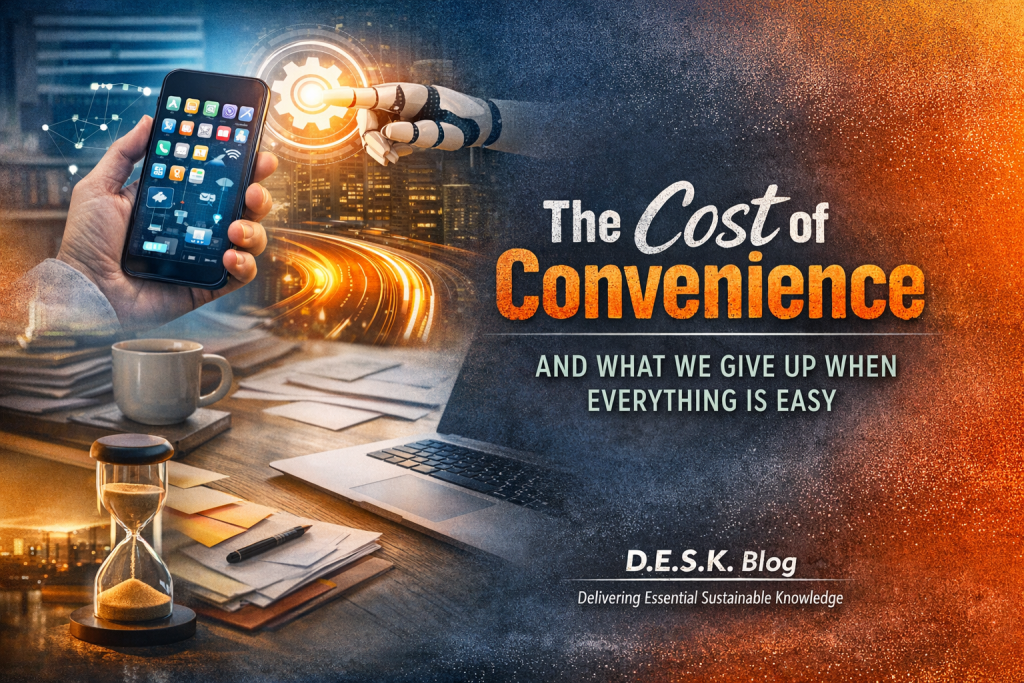
Convenience has become the default setting for modern life. We tap, swipe, automate, and move on. It saves time. It reduces friction. It promises efficiency. On the surface, that sounds like progress. But convenience is rarely neutral. It shapes how we think, how we decide, and how much responsibility we carry for our own outcomes.
This blog is not about rejecting technology or going backward. It is about understanding what happens when ease becomes the goal instead of growth. When everything is designed to be effortless, something subtle starts to fade. Awareness. Curiosity. Ownership. Over time, that loss shows up in careers, businesses, brands, and personal confidence.
The real cost of convenience is not money. It is long-term impact. Convenience trains us to expect answers without context. It rewards speed over understanding. It encourages delegation of thinking instead of strengthening it. And while that may work short term, it creates fragile systems that struggle when conditions change. Progress that lasts requires more than ease. It requires intention.
Convenience is not the enemy. Unexamined convenience is.
When Easy Becomes the Baseline
Many tools today are designed to remove steps. That sounds helpful until we realize those steps once served a purpose. They forced us to pause. They required us to think. They helped us understand how things worked.
When those steps disappear, we still get results, but we lose insight. We stopped asking why. We stop checking assumptions. We trust outcomes without understanding input.
This shows up everywhere. People rely on templates without knowing what they are templating. Businesses automate workflows without questioning whether the process itself makes sense. Brands adopt tools because everyone else is using them, not because they align with their values or goals. Over time, decisions become reactive instead of strategic. Convenience shifts the focus from learning to output. That shift feels productive, but it often creates hidden gaps. Those gaps surface later when something breaks, scales, or changes direction.
The Quiet Trade-Offs We Rarely Notice
Convenience rarely announces what it takes from us. It feels helpful in the moment. The trade-off only becomes clear later. One trade-off is reduced problem-solving ability. When answers arrive instantly, the brain stops practicing how to work through uncertainty. That skill weakens with disuse. Another trade-off is lowered tolerance for effort. When things are always easy, anything difficult feels unnecessary or broken. Growth, however, requires effort. Skills deepen through friction. A third trade-off is detachment from outcomes. When systems do everything for us, it becomes easy to blame the tool instead of examining choices. Ownership fades. In personal brands and businesses, this can be dangerous. Tools do not carry vision. People do.
Convenience and the Illusion of Progress
Progress looks impressive when dashboards update automatically and content publishes itself. Metrics move. Tasks complete. Activity increases but is not the same as direction. Convenience can create motion without meaning. It fills calendars and feeds without advancing clarity. It makes things look polished while foundations remain weak. True progress compounds. It builds understanding alongside output. It strengthens decision-making as systems grow. If a brand cannot explain why, it chooses a tool, a platform, or a strategy, it is not progressing. It is drifting. Ease should support clarity, not replace it.
How Convenience Shapes Brands Over Time
Brands built purely on convenience often struggle to adapt. They rely heavily on tools instead of principles. When platforms change, algorithms shift, or tools disappear, the brand loses momentum. Brands that last tend to know themselves well. They understand their audience. They know their purpose. They use tools intentionally. Convenience becomes a support system, not a strategy. This distinction matters.
- When convenience drives decisions, brands become reactive.
- When clarity drives decisions, convenience becomes optional.
Long-term trust is built when audiences sense thoughtfulness behind actions. People notice when a brand understands its own message instead of chasing trends.
The Personal Impact of Always Choosing Easy
Convenience does not only affect work. It affects confidence. When people rely too heavily on easy paths, they begin to doubt their ability to handle complexity. Confidence becomes conditional. It depends on tools working perfectly. That creates anxiety when systems fail or when new skills are required. Growth comes from knowing you can figure things out. That belief forms through effort and learning, not shortcuts. Choosing the easy path every time slowly erodes self-trust.
Redefining Convenience as a Tool, not a Goal
Convenience is valuable when it removes unnecessary friction, not meaningful effort. The key is intentional use. Ask better questions before adopting tools.
- What problem does this solve?
- What understanding does it require from me?
- What happens if it fails?
- What skill am I no longer practicing if I rely on this?
Convenience should free energy for thinking, not replace thinking.
Workable Methods to Balance Ease and Growth
Here are practical ways to use convenience without sacrificing long-term progress.
- Build before you automate
Understand a process manually before automating it. This ensures you know what matters and what does not. - Slow down decisions that affect direction
Speed is helpful for execution, not strategy. Take time with choices that shape identity, values, or positioning. - Audit your tools regularly
Ask whether each tool still aligns with your goals. Remove anything that creates noise instead of clarity. - Practice intentional friction
Do some things the harder way on purpose. It keeps skills sharp and perspective grounded. - Document your reasoning
Write down why you chose a system or approach. This builds institutional memory for yourself or your brand.
Convenience and Sustainable Knowledge
Sustainable knowledge is understanding that lasts beyond the tool used to acquire it. Fast information is abundant. Deep understanding is rare. Convenience favors speed. Sustainable knowledge favors comprehension. The long-term advantage belongs to those who know how things work, not just how to operate interfaces. Tools change. Principles remain.
Measuring Progress Without Being Fooled by Ease
Progress should be measured by clarity, not just output. Ask yourself:
- Do I understand my decisions better than last year?
- Can I explain my process to someone else?
- Would I know what to do if this tool disappeared?
- Is my brand stronger without this platform?
If the answer is no, convenience may be masking stagnation.
Choosing the Long Game
The long game rewards patience, curiosity, and intention. It values understanding over speed. It builds resilience instead of dependency. It favors growth that lasts instead of wins that fade. Convenience should make the long game easier to sustain, not shorter. When ease supports purpose, progress becomes durable.
Convenience is powerful. Used wisely, it can amplify growth. Used blindly, it can hollow it out. The goal is not to reject ease. It is to stay awake to its influence. Choose tools that support your thinking. Build systems that reflect your values. Slow down when direction matters. The best progress is not the fastest. It is the most intentional.